Bid-Rigging and Cover Pricing: Collaboration Boundaries for Suppliers
Recognise cover bids, bid suppression and sensitive information exchanges, and put independent-bidding controls into everyday practice.
At a glance
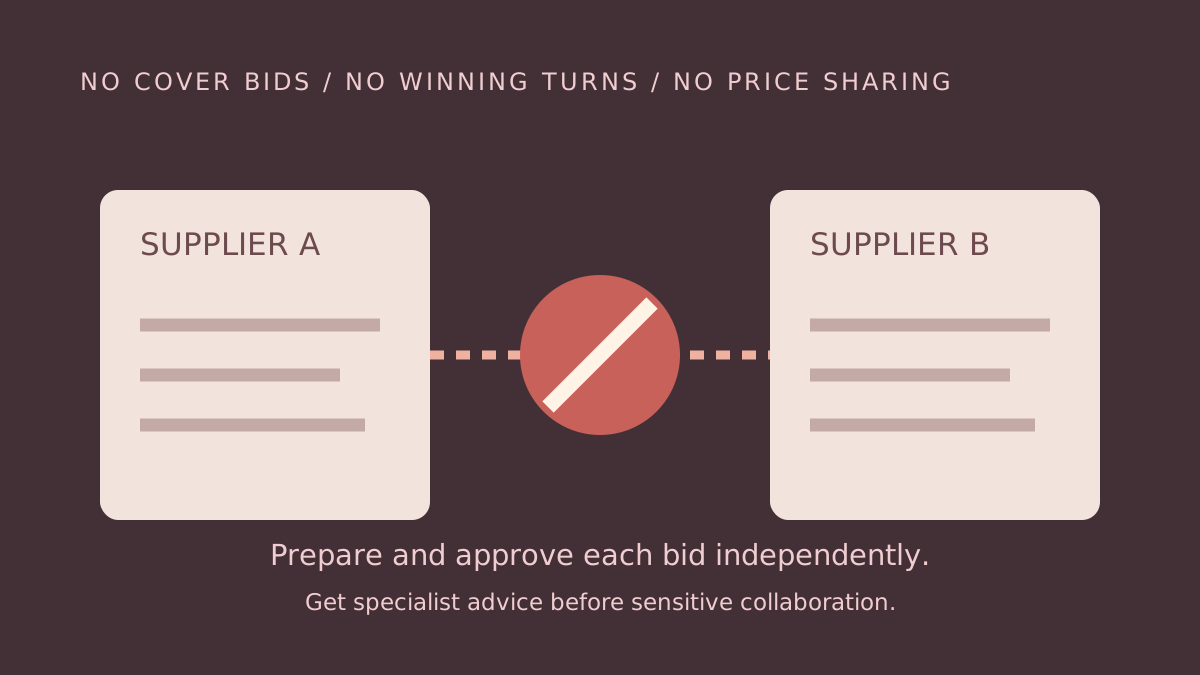
Prepare competitive bids independently. Do not agree prices, winning turns, non-participation or deliberately uncompetitive cover bids with competitors; seek competition-law advice before sensitive collaboration.
This is independent guidance from TenderSearch SA, not advice from a government authority. Verify current requirements with the issuer and these official references: Competition Commission: bid-rigging guidance (2014 publication; check current law for penalties).
A courtesy quote can be a serious problem
A competitor may ask you to submit a deliberately high quote so its preferred bid appears competitive. Calling it a courtesy, favour or administrative requirement does not make the arrangement harmless. The Competition Commission's bid-rigging guidance describes complementary or cover bidding as an arrangement designed to give the appearance of genuine competition.
The Commission also identifies bid suppression, where firms agree not to bid or to withdraw, and bid rotation, where they take turns winning. These are not ordinary commercial decisions made independently. The core concern is an agreement or coordinated practice between competitors that replaces competition with an arranged outcome.
Know what not to exchange
Avoid discussing current or future tender prices, pricing formulas, discounts, margins, geographic allocations, intended participation and planned withdrawal with competitors. A trade-association chat, messaging group or informal meeting can create risk just as a formal contract can. Do not assume a small business or low-value quotation falls outside competition concerns.
Your firm may independently decide that an opportunity is unsuitable. Record its own reasons and do not negotiate that decision with a rival. Similarly, a shared supplier's legitimate product quote is different from asking that supplier to pass your intended bid price to another bidder.
If unsolicited sensitive information arrives, stop the discussion, make clear that your business will not participate, preserve the record and obtain advice about appropriate next steps. Do not circulate the message throughout the sales team or use it to adjust your offer while pretending your process remained independent.
Distinguish genuine cooperation from an arranged competition
A legitimate joint venture or subcontracting arrangement can involve coordination needed to deliver a shared bid. That does not mean every exchange between companies calling themselves partners is safe. The purpose, necessity, scope and effect of cooperation matter, especially where those companies could also compete independently.
Use the existing joint-venture guide for structure and documentation questions, then obtain competition-law advice where the collaboration creates uncertainty. Do not use a token partnership to disguise cover pricing or a market-sharing arrangement. Tell advisers about parallel bids, shared personnel and planned subcontracting rather than seeking approval on an incomplete description.
Build independent-bidding controls
Nominate a bid owner and limit access to sensitive pricing. Record who prepared estimates, the source of supplier quotes and who approved the final offer. Train staff and external bid consultants not to request competitors' intended prices or promise reciprocal non-participation. Include an escalation route when a consultant works with more than one bidder.
Illustrative example: a competitor asks a cleaning business to bid 15% higher and offers a future subcontract in return. The business refuses, retains the message and seeks advice. It does not submit a token quote to preserve the relationship. This example illustrates a risky proposal, not a reported enforcement case or proof that ordinary subcontracting is unlawful.
Set a boundary for industry meetings
Prepare a short instruction for staff attending association or supplier events: discuss legitimate general issues, but stop discussions of intended tender prices, allocation or coordinated participation. If a conversation crosses the line, object clearly, leave where appropriate and document what occurred for the compliance lead. Meeting minutes should reflect the objection accurately. Obtain advice on the facts rather than assuming physical departure alone resolves every consequence.
Respond to concerns with evidence and advice
The Competition Commission's guidance explains reporting suspected collusive tendering and its independent-bid declaration context. Check its current complaint procedures and seek legal advice where your own business may have participated. Do not promise that reporting automatically gives immunity; leniency and cooperation questions require specialist analysis.
Suspicious similarities between bids do not, by themselves, prove an agreement. Preserve original communications and factual observations rather than publishing accusations. If an authority seeks records, do not destroy messages or invent an alternative history. The financial, reputational and potential legal consequences justify prompt professional advice, but this guide does not state a universal penalty or give an opinion on a particular arrangement.
Review these controls whenever you add a partner, consultant or shared workspace. Independent preparation should be demonstrable from the record, not merely asserted by a signature on the final day.
- Reject cover bids and winning-turn arrangements.
- Keep future prices and participation plans confidential.
- Control consultant and partner information access.
- Preserve unsolicited approaches.
- Seek advice before collaboration or reporting decisions.
Frequently asked questions
Is a deliberately high courtesy quote harmless?
No. An agreed uncompetitive quote can be cover bidding. Do not arrange it with a competitor.
Are all joint ventures prohibited?
No. Genuine cooperation and collusive tendering are different, but a JV label is not a blanket exemption. Obtain advice on the actual arrangement.
Found this useful? Share it with another business — it costs you nothing and helps us reach more South African bidders.
Put your bid preparation into practice
Browse public tender previews, check the official requirements, then shortlist opportunities that fit your business. Starter is R149/month for search and saves. Professional at R299/month adds daily keyword email alerts, unlimited saves and closing-date reminders.
Compare tender subscription plans