Tender Objections and Reviews: Identify the Route Before Time Runs Out
Assemble the decision, dates, policy and evidence a lawyer needs to distinguish complaints, internal remedies and judicial review.
At a glance
Identify the institution, decision, applicable policy and available internal remedies immediately. Obtain specialist legal advice on the correct route and deadlines; a general complaint is not necessarily a valid objection or review.
This is independent guidance from TenderSearch SA, not advice from a government authority. Verify current requirements with the issuer and these official references: Department of Justice: PAJA judicial review and internal remedies · Department of Justice: PAJA written reasons · Government: Public Procurement Act 28 of 2024 — commencement to be proclaimed · National Treasury: commencement and transition statement, 13 August 2024 · Treasury: Draft General Public Procurement Regulations 2026 (consultation text, not effective rules).
Start with the decision and the institution
A tender dispute is not governed by one universal complaint form or deadline. The buyer may be a national department, public entity, municipality or municipal entity, and the applicable framework and policy matter. Establish the precise decision you want to challenge: exclusion, scoring, cancellation, intended award, final award or another administrative act.
Record who made the decision, its stated date, when you became aware of it, how notice reached you and whether reasons were supplied. Preserve evidence of those dates. A result heard through a competitor and a formal notice received later can raise different questions; a lawyer needs the facts, not a date chosen because it produces a more comfortable deadline.
Distinguish three kinds of route
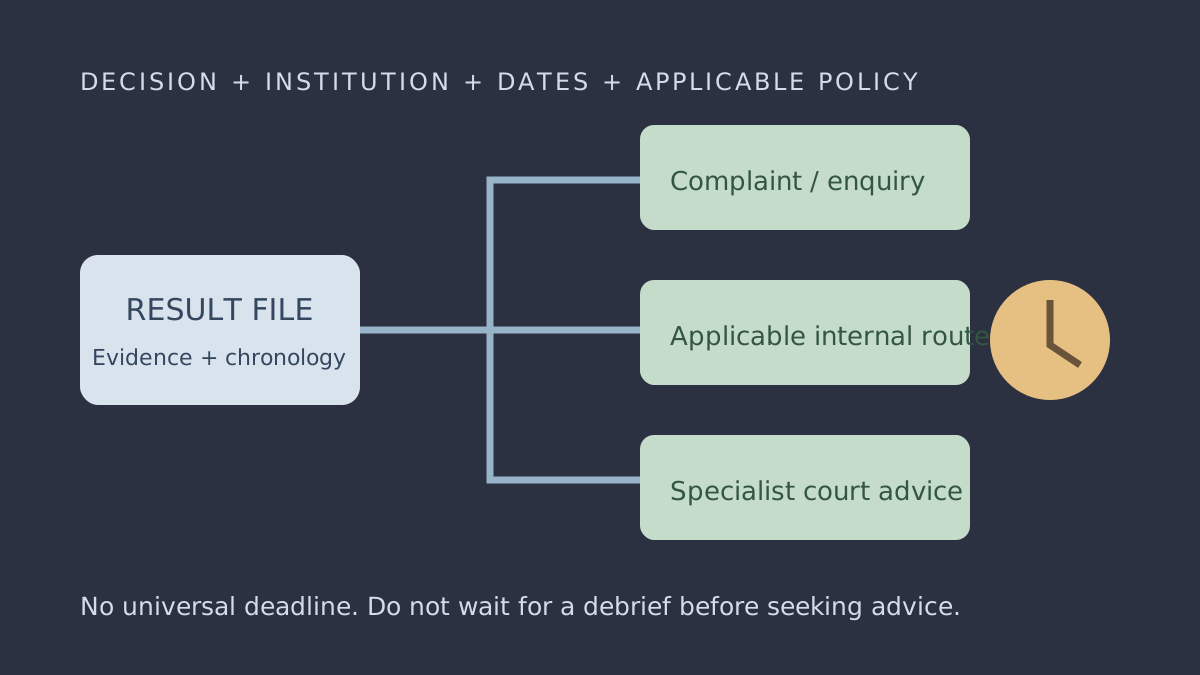
A service complaint or enquiry asks an institution to address a concern. It may be useful, but does not automatically satisfy a legally prescribed objection or appeal process. An internal remedy depends on the applicable law and policy: it can require a designated recipient, stated grounds and a particular procedure.
Judicial review asks a court to assess the legality of administrative action; it is not simply a new scoring exercise by a disappointed bidder. The Justice Department's PAJA guidance explains the importance of exhausting available internal remedies, subject to the legal rules and possible exceptions. Your adviser must determine which remedies actually exist and apply.
Do not assume that sending the same email to many offices preserves every route. Nor should you assume a Treasury complaint channel can overturn a decision, stop implementation or grant the same relief as a court. Identify the powers of the body you are approaching.
Treat time as a live risk
The Justice Department's PAJA judicial-review guidance describes a 180-day framework linked to exhaustion of internal remedies or awareness where no internal remedies exist. The actual statutory test also requires attention to unreasonable delay and the facts triggering time. Other objections or urgent applications may require action much sooner.
Do not turn that summary into a universal 180-day waiting period. Asking for reasons, negotiating or attending a debrief may not stop another clock. Where contract implementation is imminent, seek urgent advice about preservation of rights and appropriate relief. The correct response can depend on what has already been signed or performed.
Prepare an adviser-ready evidence bundle
Arrange the advert, complete bid pack, amendments, your submitted response, receipts, published evaluation rules, result notice, reasons and correspondence chronologically. Provide a one-page chronology and an index. Identify disputed findings with the relevant criterion and submitted evidence rather than asserting that your business deserved to win.
Illustrative issue statement: 'The notice says our reference certificate was missing; the final submitted PDF contains it on page 42, and the receipt identifies that file.' That is a factual question an adviser can investigate. 'The winner must have influence' is an allegation requiring evidence and should not replace analysis.
Specify the outcome you need advice about
Tell your adviser whether you want reasons, reconsideration, a pause in implementation or another remedy, and what commercial harm you anticipate. Provide known contract-signing or mobilisation dates without guessing missing facts. Identify practical constraints such as ongoing work for the buyer. This helps counsel assess urgency and available relief, while avoiding the assumption that every successful challenge produces an award to the complaining bidder.
Keep reform proposals separate from current remedies
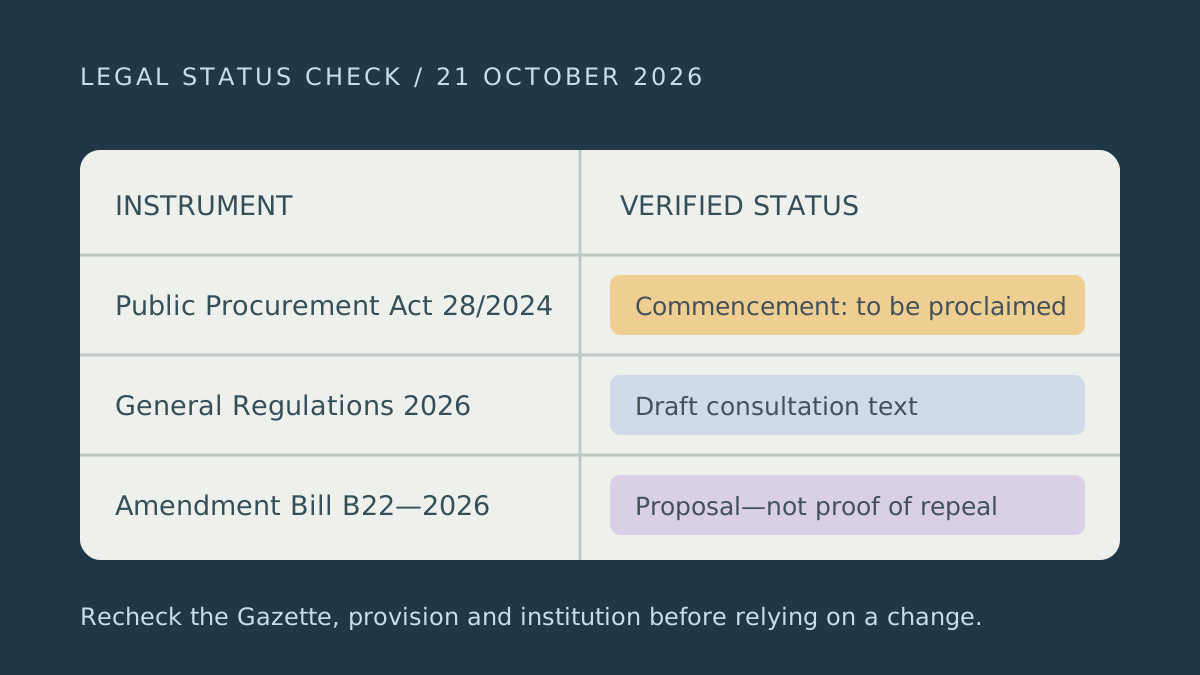
At the 21 October 2026 editorial check, the official Public Procurement Act page still records commencement as 'To be proclaimed'. The 2026 General Regulations inspected are draft consultation material. Do not assume a proposed Procurement Tribunal is operational or that proposed complaint periods are available merely because an article describes the future regime.
Ask a specialist to verify the current Gazette position, relevant provisions, institutional category and any applicable court orders before relying on a remedy. This educational workflow has not been presented as a specialist-reviewed legal opinion. Do not lodge a document based only on this guide. Legal cost, available relief, prospects and commercial objectives should all form part of an informed decision.
- Identify decision, institution and governing policy.
- Preserve awareness and notification dates.
- Check internal remedies and correct recipient.
- Obtain advice before waiting for feedback.
- Do not use draft procedures as current law.
Frequently asked questions
Is there one objection deadline for all South African tenders?
No. The institution, decision, applicable law, policy and remedy determine the position. Obtain advice promptly rather than relying on a generic deadline.
Can I use a Procurement Tribunal described in the 2026 draft?
Do not assume a draft creates a current remedy. Verify commencement and effective regulations. The official Act page checked for this guide still lists commencement as to be proclaimed.
Found this useful? Share it with another business — it costs you nothing and helps us reach more South African bidders.
Put your bid preparation into practice
Browse public tender previews, check the official requirements, then shortlist opportunities that fit your business. Starter is R149/month for search and saves. Professional at R299/month adds daily keyword email alerts, unlimited saves and closing-date reminders.
Compare tender subscription plans