Spot a Fake Tender Before You Pay or Send Stock
Authenticate an issuer, tender reference, order and payment request independently, with a practical stop-and-check decision tree.
At a glance
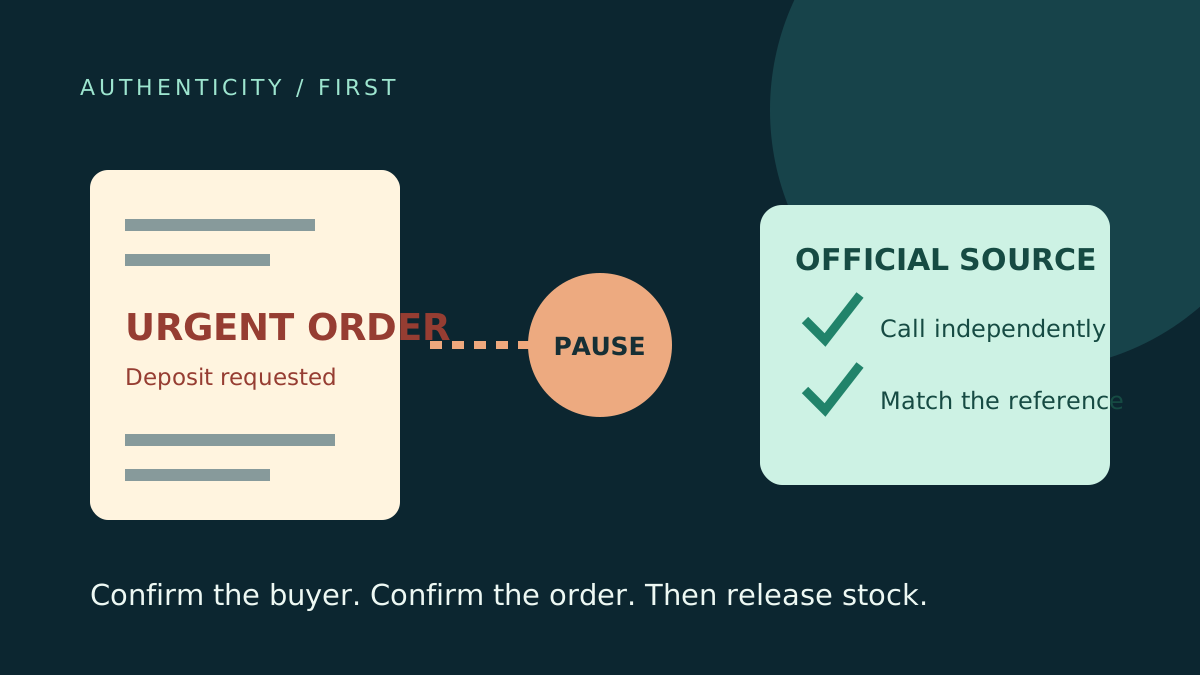
Pause any payment or dispatch until you have independently confirmed the notice, buyer and order using contact details obtained from the issuer's official website—not the incoming message.
This is independent guidance from TenderSearch SA, not advice from a government authority. Verify current requirements with the issuer and these official references: National Treasury eTenders: official notices · Eskom: procurement scam alert and independent verification advice.
A convincing document is not authentication
A logo, a purchase-order number and an urgent delivery date are cheap to imitate. Procurement fraud often works because the requested product looks relevant to your business, or because an apparent buyer introduces you to a supposed specialist manufacturer. The transaction can look profitable while the deposit goes to an unrelated account. Treat verification as a separate commercial approval, not a quick visual check by the salesperson hoping to close the order.
Eskom's official procurement scam warning describes both bogus bulk orders and rare-equipment schemes involving a recommended supplier. It also warns that a genuine-looking sender address can be spoofed. The lesson is broader than memorising a list of fraudulent domains: use an independent channel, because the addresses used by criminals change.
Use this verification decision tree
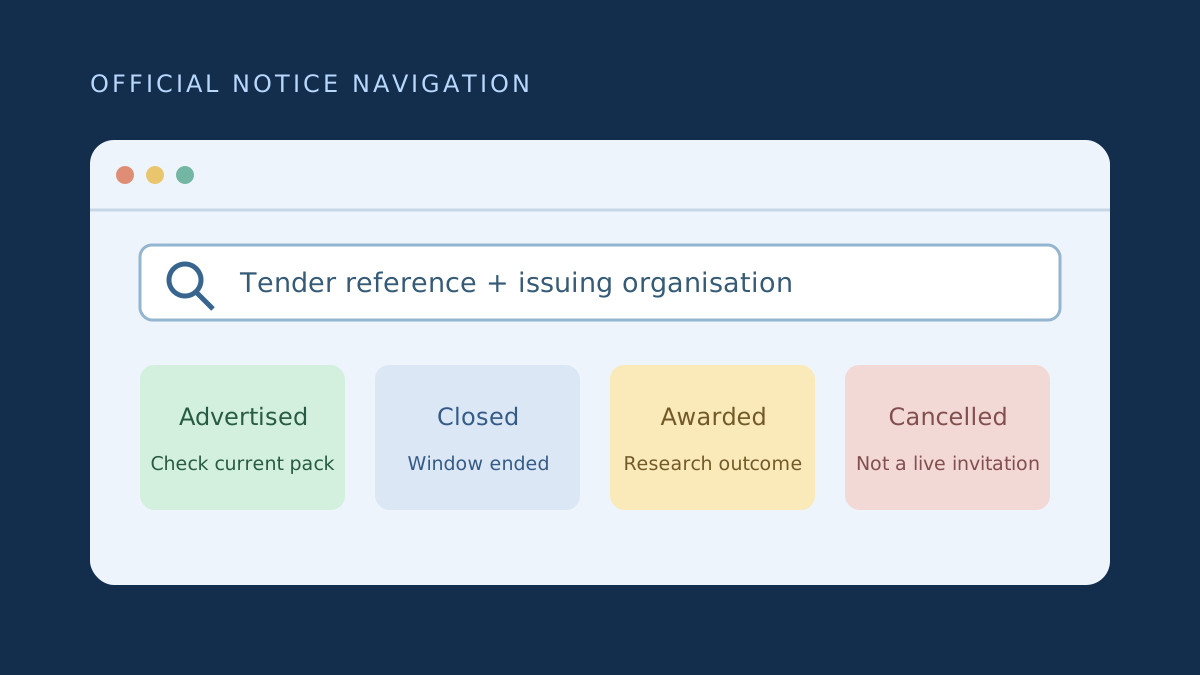
First ask whether you can locate the reference on the issuer's official procurement site or eTenders. If you find it, compare scope, dates, submission channel and contact details against the incoming pack. A matching reference is only a starting point: criminals can copy a real notice and substitute banking or delivery instructions.
If you cannot find it, do not automatically accuse the sender of fraud. Some legitimate procurement is published or communicated through different authorised channels. Obtain the issuer's switchboard or procurement-office contact from its official website and ask it to confirm the reference and the named buyer. If confirmation is unavailable, keep the transaction on hold; absence of confirmation is not approval.
Next verify the purchase order itself, the delivery point and the person authorised to receive goods. Ask the official procurement office whether any changed instruction is genuine. An apparently correct government address does not establish that someone meeting a truck outside the gate is an authorised recipient.
Separate a legitimate fee from a pressure payment
Do not assume all legitimate bid-document arrangements are free. Instead, verify any stated document fee against the issuer's published instructions and confirm the payee independently. A fee to secure an award, release a confidential shortlist or guarantee selection is a serious warning sign. A discovery subscription is also not a payment to government or permission to bid.
When an unfamiliar manufacturer demands a deposit, independently check the company's existence, trading history, bank-account ownership and product availability. Do not use only the phone numbers supplied by the alleged buyer. Your bank may help with account checks, but a matching account name does not prove the underlying order is genuine.
Give the verifier an explicit release decision
Use three outcomes: verified and approved; unresolved and held; or mismatch escalated. Name the person who can change a hold to an approval, and require new evidence for that change. Do not let a sales deadline become the reason a verification step disappears. For repeat buyers, recheck material changes rather than treating the first successful transaction as permanent authentication.
Keep an authentication record
Use a simple register: date received; reference; official URL; independently sourced telephone number; person contacted; what was confirmed; unresolved differences; and the manager who authorised payment or dispatch. Preserve original emails and attachments rather than only screenshots. Record each later change as a new verification event, especially banking and delivery changes.
Illustrative example: a supplier receives an order for pumps and a recommendation to buy them from one distributor. The real procurement office confirms the reference belongs to office furniture. The supplier stops the purchase, preserves the messages and reports the mismatch. This example illustrates a decision process, not a reported case or proof that all exclusive-distributor requirements are fraudulent.
If money or goods have already moved
Contact your bank immediately through its official fraud channel and explain the transaction. Preserve payment references, recipient details, messages, delivery records and names. Eskom's warning advises victims to open a fraud case with SAPS and alert the bank used for the deposit. Also notify the impersonated issuer through its published fraud-reporting route. Recovery is not guaranteed; speed and a clear evidence trail matter.
Do not pay a second person who promises to recover the first payment, and do not publish identity documents or bank details on social media while asking for help. Share evidence securely with the authorities and your advisers. Introduce two-person approval for unusual first orders so that commercial enthusiasm cannot bypass verification.
- Match the official reference and scope.
- Call an independently sourced issuer contact.
- Confirm payee, order and authorised delivery point.
- Resolve mismatches before releasing money or stock.
- Keep the confirmation and approval trail.
Frequently asked questions
Is a notice genuine just because it appears on eTenders?
A real notice helps verify the opportunity, but an email can copy it and replace payment or delivery instructions. Confirm the actual transaction independently.
Does a missing search result prove fraud?
No. Confirm the procurement channel directly with the issuer. Keep payment and dispatch on hold while the uncertainty remains.
Found this useful? Share it with another business — it costs you nothing and helps us reach more South African bidders.
Put your bid preparation into practice
Browse public tender previews, check the official requirements, then shortlist opportunities that fit your business. Starter is R149/month for search and saves. Professional at R299/month adds daily keyword email alerts, unlimited saves and closing-date reminders.
Compare tender subscription plans