Turn a Functionality Rubric into an Evidence-Based Technical Proposal
Build a criterion-to-evidence matrix so a technical evaluator can find verifiable proof, project methods and staff commitments.
At a glance
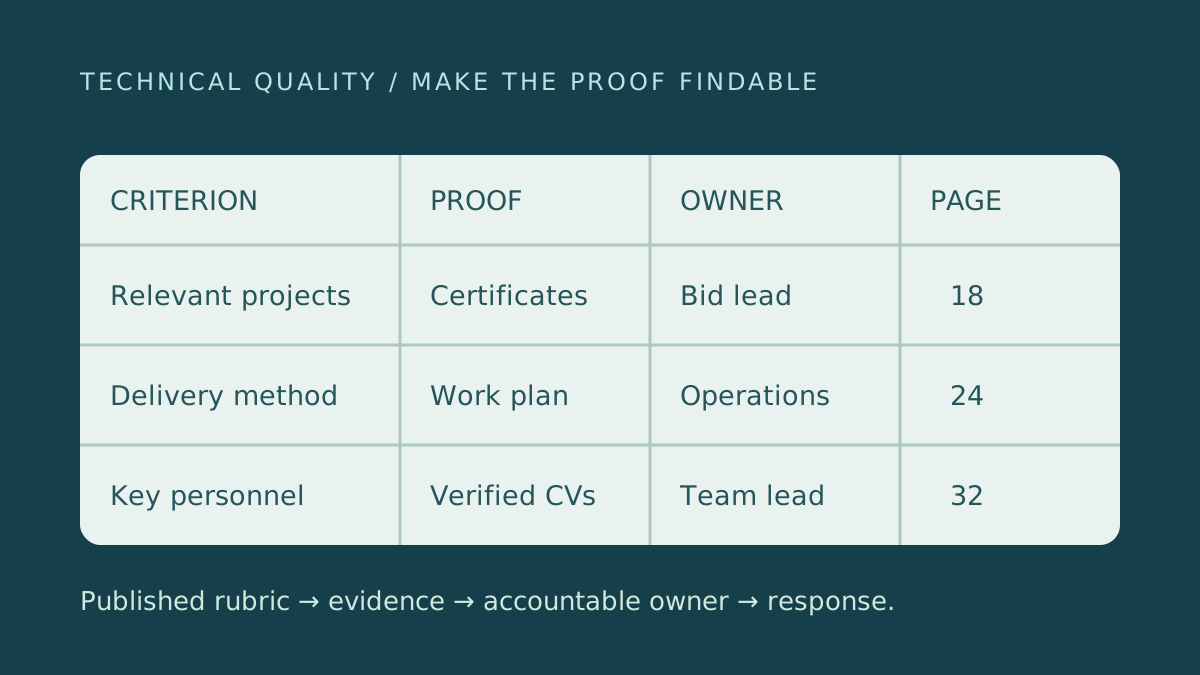
Copy each published technical criterion into an evidence matrix, assign an owner and page reference, and test the completed proposal against the exact scoring rubric before submission.
This is independent guidance from TenderSearch SA, not advice from a government authority. Verify current requirements with the issuer and these official references: National Treasury eTenders: official notices · Published issuer example: methodology evaluation criteria (example only, not a universal rubric) · Preferential Procurement Regulations 2022: Gazette 47452.
Write to the published assessment
A technical proposal should make it easy to assess what you will deliver and why your evidence supports the published criteria. It is not primarily a brochure. Start with the issuer's functionality rubric, any minimum threshold and the stated evaluation sequence. Keep technical assessment separate from price and preference points unless the documents expressly describe another model.
There is no universal functionality threshold or weighting that can safely replace the tender's own schedule. If the pack contains conflicting criteria, use the official clarification process before the question deadline. Do not quietly choose the more favourable interpretation and hope the evaluator does the same.
Create an evidence matrix before writing prose
Use columns for criterion wording, subcriterion, maximum score, required proof, proposed evidence, evidence owner, gap, response page and final reviewer. Preserve the rubric's wording so your team does not accidentally replace a measurable requirement with a vague heading. Where a criterion asks for completed comparable projects, a list of all clients is not automatically the required proof.
Assign one accountable owner to each row. Ask that person to supply the actual document or verified data, not simply mark the row complete. Track whether the evidence must be signed, dated, certified, recent or in a particular format. Cross-reference supporting material precisely enough that someone outside your business can locate it.
Separate mandatory eligibility from scored quality. Failing a gate may prevent scoring altogether; a technically strong method does not necessarily cure missing mandatory evidence. Likewise, meeting a minimum gate does not justify claiming the maximum quality score.
Make the method executable
For each workstream, explain activities, sequencing, responsibilities, resources, dependencies, controls and measurable outputs. Tie these to the specified locations, service levels and timeframes. Replace statements such as 'we offer excellent support' with a service workflow showing how an incident is received, assigned, escalated and closed.
Illustrative example: a facilities proposal requires an emergency-response method. The team explains the reporting channel, duty manager, dispatch decision, access dependency, response record and client confirmation. It identifies which steps require the client's cooperation instead of promising an unconditional response time that cannot be met. This is a writing example, not a claim about an actual tender rubric.
Prove resources without exaggerating them
Confirm availability of named personnel and distinguish employees, subcontractors and proposed recruits. A CV establishes experience only to the extent its contents can be verified; it does not prove that person will be available for the contract. Check permissions before including personal information and provide the evidence the issuer actually requires.
Use honest project roles. If your employee worked on a project at a previous employer, do not present that project as your current company's completed contract. If a partner supplies specialist capability, show the authorised commitment and the relationship the tender permits. Link to your reference evidence register rather than inventing a polished but uncheckable case study.
Resolve evidence gaps before polishing the layout
Colour-code the matrix internally: verified proof available, proof requested, or requirement not met. Give requested items a due date and an owner. If an item cannot be supplied, assess the scoring and eligibility consequences honestly before deciding to bid. Do not let a designer's finished layout conceal an unresolved gap. Final formatting should make valid evidence easier to find, not make weak evidence appear more certain than it is.
Run an evaluator-style review
Give a reviewer the rubric and the finished proposal without a verbal explanation. Ask the reviewer to identify proof for every claimed item and flag unsupported statements, broken page references and inconsistent staff allocations. Treat any self-score as an internal diagnostic only; it is not a predicted result or an entitlement to points.
Finish with a consistency check between method, staffing, schedule and price. A method that promises daily site visits while the cost schedule funds monthly visits needs correction before submission. Lock the final page numbering after assembling appendices, then retain the submitted version. If an addendum changes the rubric, update the matrix and repeat the affected reviews rather than adding an isolated paragraph at the end.
- Preserve exact criteria and thresholds.
- Assign owners and proof for each row.
- Make method, staff and schedule consistent.
- Verify reference and personnel claims.
- Check final page references against the uploaded file.
Frequently asked questions
Can a better price compensate for failing functionality?
Not where the published process requires a minimum functionality threshold before later evaluation. Read the actual sequence and threshold in the bid pack.
Should I repeat the company profile under every criterion?
Use concise criterion-specific answers and accurate cross-references. A generic profile is not a substitute for the specific proof requested.
Found this useful? Share it with another business — it costs you nothing and helps us reach more South African bidders.
Put your bid preparation into practice
Browse public tender previews, check the official requirements, then shortlist opportunities that fit your business. Starter is R149/month for search and saves. Professional at R299/month adds daily keyword email alerts, unlimited saves and closing-date reminders.
Compare tender subscription plans