Supplier Panels and Framework Agreements: What Appointment Really Means
Separate panel admission from actual orders, read call-off and allocation clauses, and assess revenue uncertainty before committing capacity.
At a glance
Panel appointment is not automatically a purchase commitment. Read the framework's ordering, allocation, pricing and termination clauses before treating it as revenue or reserving capacity.
This is independent guidance from TenderSearch SA, not advice from a government authority. Verify current requirements with the issuer and these official references: National Treasury eTenders: official notices · uMgungundlovu tender 12/2026: ICT panel utilisation and RFQ terms (issuer-specific example) · National Treasury: General Conditions of Contract (July 2010) · Treasury: Draft General Public Procurement Regulations 2026 (consultation text, not effective rules).
Admission and work are separate decisions
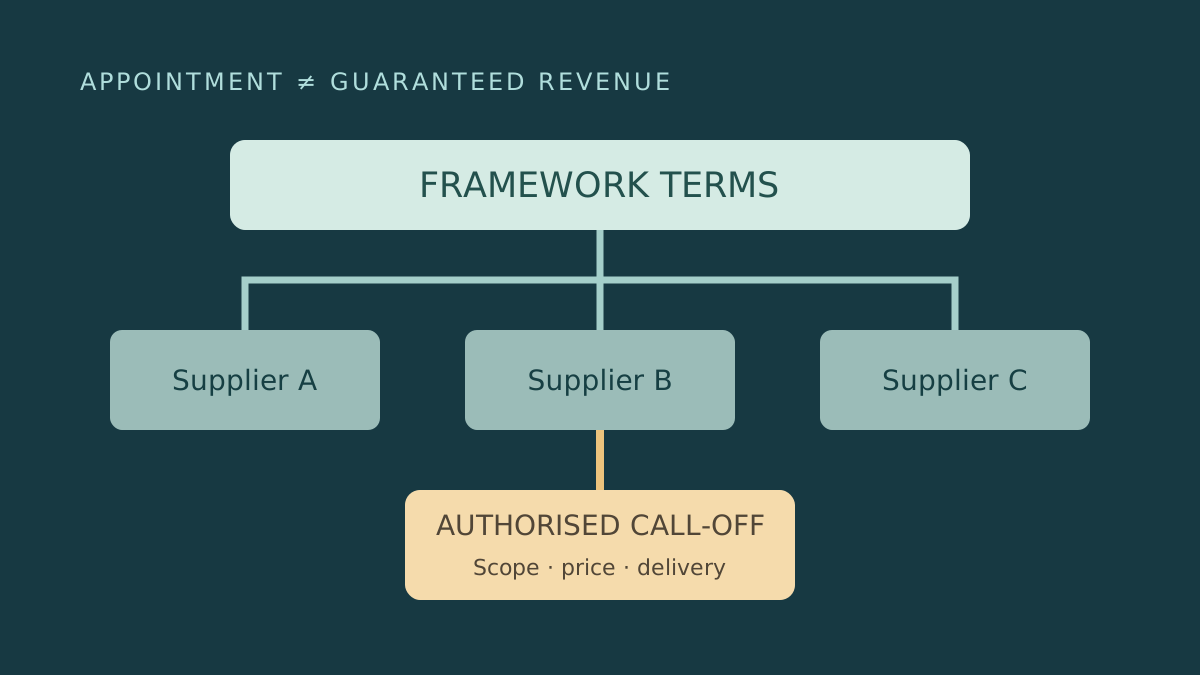
A panel or framework can establish suppliers and terms for future purchases without ordering a fixed volume at appointment. Buyers use different models, so the title alone tells you little. One arrangement may specify binding minimum quantities; another may allow work only when a separate order is issued. Your first task is to identify exactly what the buyer commits to and what remains optional.
Treat this guide as a contract-reading workflow, not a claim that every framework follows a single statutory model. In the published uMgungundlovu ICT panel invitation 12/2026, the utilisation section states that there is no guaranteed minimum workload and describes further RFQs among appointed suppliers. That is an issuer-specific example, not a rule imposed on every framework. The 2026 draft General Regulations are consultation material, not effective replacement terms.
Map how an order becomes authorised
Draw the sequence described in the documents: appointment, request for quotation or mini-competition if required, allocation decision, purchase order, acceptance of that order, delivery and payment. For each step, write who acts and what document proves authority. If no allocation mechanism is stated, ask a written clarification before closing rather than assuming all panel members receive equal work.
Look for rotation, ranking, geographical allocation, capacity checks or competition between panel members. These are possible contractual mechanisms, not universal entitlements. Check whether the buyer can procure outside the panel and whether appointment is exclusive. Ask how new sites, urgent orders and work above a supplier's capacity are handled.
Identify who may issue a binding call-off and whether individual departments or sites can place orders independently. A technician's request to start work may not satisfy the ordering clause. Build an internal rule that staff verify the authorised order before committing material or labour.
Read pricing as an operating obligation
Check whether appointment fixes rates, establishes maximum rates or requires a fresh quote for each order. Record tax treatment, delivery zones, minimum order sizes and any allowed adjustments. A rate schedule can become commercially painful if fuel, exchange rates or staffing costs change while the agreement allows no adjustment.
Illustrative example: a maintenance supplier joins a two-year panel with no minimum allocation. It budgets only the administration cost of maintaining readiness and treats each future authorised work order as a separate capacity decision. It does not employ a full additional team on the assumption that a panel letter guarantees monthly turnover. This is a planning example, not a description of a specific issuer's contract.
Check commitments that survive low demand
A framework can require insurance, licences, reporting, standby availability or security even when little work arrives. List the recurring cost of those obligations and what happens if you decline a call-off. Review performance measures, response times, termination rights and any conditions for removal from the panel.
Distinguish contract expiry from the completion of work already ordered. Determine whether orders may extend beyond the framework end date and which terms then apply. Similarly, do not assume appointment renews automatically: an extension or fresh procurement may be required under the actual arrangement.
Keep a separate call-off decision record
For each request, record whether it falls within the appointed scope, the required response time, available capacity and the person authorised to accept it. Check whether rates include the requested site and whether a new quotation is required. Retain declined or unallocated requests too, with factual reasons. This prevents sales teams from counting every enquiry as an order and helps explain why appointment and actual utilisation differ.
Make an evidence-based appointment decision
Before signing, summarise the commercial exposure on one page: guaranteed quantity if any; non-guaranteed potential; ordering authority; allocation mechanism; rate validity; readiness costs; maximum concurrent capacity; exit terms; and unresolved questions. Ask a qualified adviser to review ambiguous liability, security or exclusivity provisions. A prestigious buyer name does not compensate for an obligation your business cannot fund.
After appointment, store the signed framework and maintain an order register. Each row should link the call-off to scope, authorised price, delivery dates and acceptance evidence. Report panel revenue using actual orders and recognised performance, not the headline framework ceiling. When searching for opportunities, distinguish applications to join a panel from competitions open only to already-appointed suppliers.
- Locate any guaranteed minimum explicitly.
- Understand how work is allocated.
- Verify ordering authority.
- Cost readiness and fixed-rate exposure.
- Track each call-off separately.
Frequently asked questions
Does a panel appointment guarantee work?
Only an express contractual commitment can establish a minimum. Do not infer guaranteed orders from admission, a ceiling value or a panel's duration.
Can the buyer run a further competition?
Read the published allocation and call-off terms. Some arrangements require further quotations or competition; do not assume appointment alone settles the price or allocation.
Found this useful? Share it with another business — it costs you nothing and helps us reach more South African bidders.
Put your bid preparation into practice
Browse public tender previews, check the official requirements, then shortlist opportunities that fit your business. Starter is R149/month for search and saves. Professional at R299/month adds daily keyword email alerts, unlimited saves and closing-date reminders.
Compare tender subscription plans