RFQ, RFP, RFI and EOI: What Response Is the Buyer Asking For?
Identify whether a public notice seeks a quotation, proposal, market information or expression of interest before spending time on a response.
At a glance
Read the requested output and stated outcome, not just the acronym. An information request may support market research without making any contract available for award.
This is independent guidance from TenderSearch SA, not advice from a government authority. Verify current requirements with the issuer and these official references: National Treasury eTenders: official notices.
Use the acronym as a clue, not a complete rule
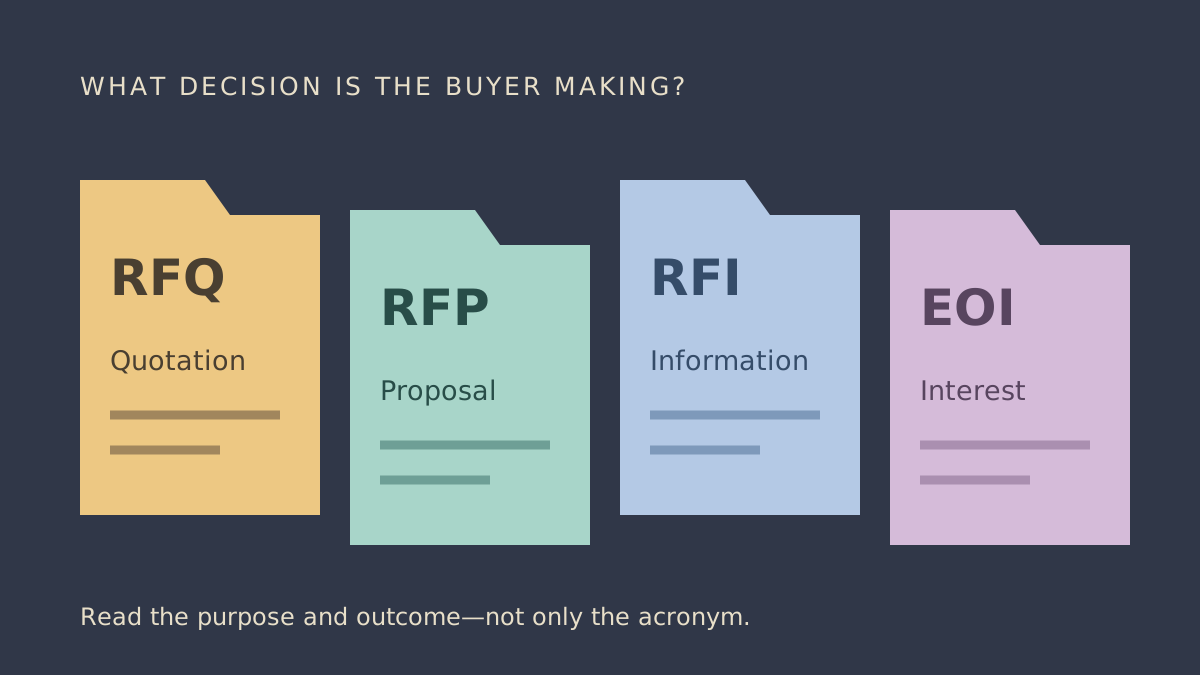
Public notices use RFQ, RFP, RFI and EOI to describe different procurement interactions. Usage varies between institutions, and the same abbreviation can conceal a complex response. Start by reading the purpose, eligibility, required deliverables and outcome clauses. Do not assign a universal monetary threshold or response deadline from the acronym alone.
The official eTenders notice inventory is a useful place to compare how actual issuers label requirements. Always return to the attached issuer instructions for a particular opportunity. A generic glossary cannot tell you whether a response is binding, whether a shortlist will follow or whether the buyer reserves the right not to proceed.
A practical response decision table
RFQ usually means request for quotation: the buyer wants pricing against a defined requirement. Your decision questions are whether the specification is clear, how quantities and delivery are stated, and what compliance evidence accompanies the quote. A short invitation can still require substantial technical proof or a prescribed pricing schedule.
RFP usually means request for proposal: the buyer seeks a proposed solution, method or service arrangement as well as commercial information. Look for functionality criteria, assumptions, deliverables and evaluation stages. Do not submit a glossy company profile when the buyer asks for a detailed implementation plan supported by evidence.
RFI usually means request for information: the buyer may be researching the market or testing feasibility. Check for explicit wording that no award will result. EOI usually means expression of interest: the buyer may be identifying interested and potentially capable participants, possibly for a later stage. Neither label automatically promises that respondents will be invited to a subsequent tender.
Choose the right effort and approvals
For a quotation, assign a pricing owner and confirm the offered product, delivery lead time, taxes and quote validity. For a proposal, build a response matrix against the published criteria and allocate technical writing responsibilities. For information or interest requests, decide what commercially sensitive information you are willing and authorised to disclose.
Keep non-binding market input separate from binding commercial offers. If the buyer asks indicative pricing, label it as requested and include only qualifications the process permits. Do not assume you can later retract a firm quote because you thought the notice was informal. Ask the issuer to clarify the intended legal effect where the language is inconsistent.
Protect information without ignoring the instructions
An RFI can ask about product capability, implementation options or market constraints. Avoid disclosing proprietary designs, customer personal information or supplier confidential prices unnecessarily. Identify sensitive material and request clarification about treatment where needed. A confidentiality label is not a guarantee against every legally required disclosure.
Illustrative example: an IT firm sees an RFI about possible service models. It provides capability ranges, implementation dependencies and clearly described indicative cost drivers rather than a signed offer for a fixed deployment. When a later RFP is advertised, it prepares a new response to that RFP. Participation in the RFI does not excuse it from the later deadline or qualification rules.
Check the notice's closing language
Look for whether the stated deadline is for questions, registration of interest or the final response. These can be different dates in the same process. Record all three where present, with the action each requires. If an EOI requires an initial eligibility schedule, do not postpone it because you expect detailed proposals later. Your response plan must match the actual stage, not the amount of writing suggested by the acronym.
Record what happens next
Your opportunity register should include notice type as published, your interpretation, response due date, submission channel, binding or indicative status, expected next stage and an owner for follow-up. Keep any issuer answers that explain ambiguous terminology. If no timetable for the next stage is stated, mark it unknown rather than inventing a likely advert date.
After responding, monitor the official channel for outcomes and new invitations. A response acknowledgement is not a shortlist decision, and a shortlist is not a contract. If the next process is restricted, verify eligibility directly rather than assuming a public advert admits everyone. The best time saving is not using a shorter template; it is recognising what decision the buyer is actually trying to make.
- Read purpose and intended outcome.
- Identify binding versus indicative commitments.
- Match the response format to the request.
- Protect sensitive information lawfully.
- Monitor the stated next stage without assuming admission.
Frequently asked questions
Is every RFQ a small purchase?
Do not infer a universal value threshold from the label. The issuer's applicable rules and the actual invitation determine the process.
Will responding to an EOI guarantee an RFP invitation?
No. Check the EOI's stated selection and next-stage terms. An expression of interest can be market research or a qualification stage without a promised award.
Found this useful? Share it with another business — it costs you nothing and helps us reach more South African bidders.
Put your bid preparation into practice
Browse public tender previews, check the official requirements, then shortlist opportunities that fit your business. Starter is R149/month for search and saves. Professional at R299/month adds daily keyword email alerts, unlimited saves and closing-date reminders.
Compare tender subscription plans